Strength Training: The Missing Piece of Healthy Aging

Most people think healthy aging is about avoiding disease, taking supplements, or maintaining a healthy weight. While those factors certainly matter, one of the most powerful predictors of how well you age is something far simpler: your strength.

Strength training isn't just about building muscle or improving your appearance. It's about preserving your independence, protecting your metabolism, reducing your risk of injury, and maintaining the quality of your life as you age.

At Movement Lab, we believe strength training is one of the most important investments you can make in your future health.

Aging Is Not the Problem—Loss of Strength Is

Many of the challenges commonly associated with aging are not caused by age itself. They are often the result of losing muscle mass, strength, balance, and mobility over time.

Starting as early as your 30s, adults naturally begin to lose muscle tissue if they are not actively working to maintain it. This process, known as sarcopenia, accelerates with age and can contribute to:

  • Decreased mobility

  • Increased risk of falls

  • Reduced bone density

  • Slower metabolism

  • Loss of independence

  • Increased risk of chronic disease

The good news? Strength training is one of the most effective ways to slow, stop, and even reverse many of these changes.

Muscle: Your Longevity Organ

Researchers have begun referring to skeletal muscle as a "longevity organ" because of the significant role it plays in overall health.

Muscle tissue helps:

  • Regulate blood sugar

  • Improve insulin sensitivity

  • Support hormone health

  • Reduce inflammation

  • Protect joints

  • Maintain bone density

  • Improve balance and coordination

  • Increase metabolic rate

In fact, studies consistently show that individuals with greater strength and muscle mass tend to have lower rates of chronic disease and longer, healthier lives.

The goal isn't to become a bodybuilder. The goal is to maintain enough strength and muscle to continue doing the things you love for decades to come.

Strength Training Supports Everyday Life

When people hear "strength training," they often picture heavy barbells and intense gym sessions. In reality, strength training is simply practicing movements that make your body more capable.

Think about the activities you perform every day:

  • Carrying groceries

  • Lifting grandchildren

  • Climbing stairs

  • Getting off the floor

  • Walking long distances

  • Gardening

  • Traveling

  • Playing recreational sports

Every one of these activities requires strength.

Without adequate strength, everyday tasks become more difficult and fatigue becomes more common. With adequate strength, daily life feels easier and more enjoyable.

Strength Training Improves Bone Health

Bone density naturally declines as we age, especially in women after menopause.

This decline increases the risk of fractures and osteoporosis, which can significantly impact independence and quality of life.

Strength training provides a unique stimulus that encourages bones to remain strong and resilient. When muscles pull against bone during exercise, the body responds by strengthening the skeletal system.

For many adults, strength training may be one of the most effective tools available for preserving bone health.
Better Blood Sugar, Better Health

Many adults focus on cardiovascular exercise for health benefits, but strength training has a profound impact on metabolic health as well.

Muscle acts like a storage tank for glucose. The more muscle you have, the better your body becomes at utilizing carbohydrates and regulating blood sugar.

This can help:

  • Improve insulin sensitivity

  • Reduce the risk of Type 2 Diabetes

  • Support healthy body composition

  • Increase energy levels

  • Reduce cravings and energy crashes

For individuals struggling with weight management, insulin resistance, or metabolic dysfunction, strength training should be a foundational component of their health plan.

Strength Training Helps Prevent Falls

Falls remain one of the leading causes of injury among older adults.

Many people assume falls are simply a part of getting older, but balance and stability can be trained.

A well-designed strength program improves:

  • Lower-body strength

  • Core stability

  • Coordination

  • Reaction time

  • Confidence in movement

By improving these qualities, individuals can significantly reduce their risk of falling and maintain greater independence as they age.

It's Never Too Late to Start

One of the biggest misconceptions about strength training is that it's only beneficial if you start young.

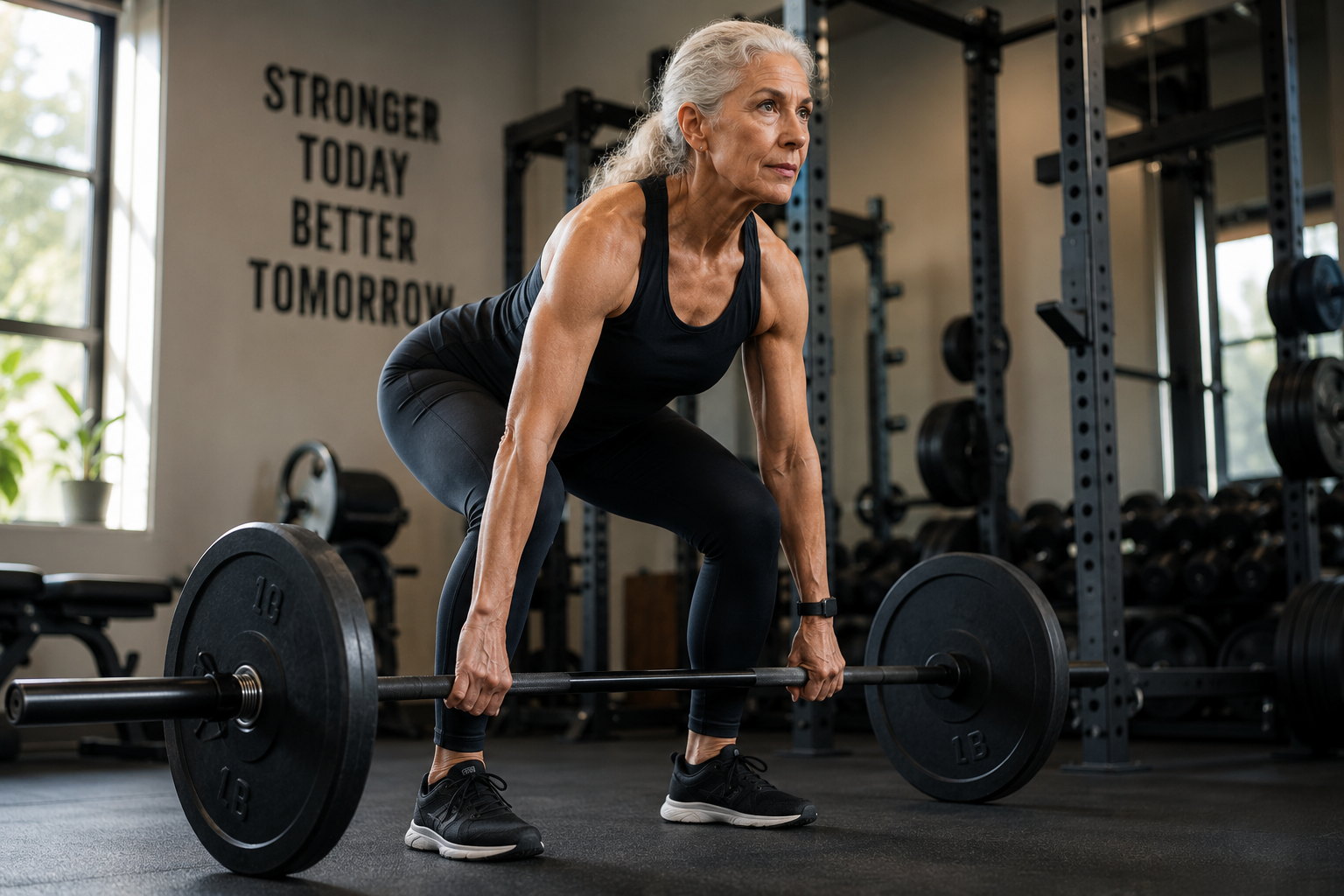
Research consistently demonstrates that adults in their 60s, 70s, and even 80s can gain strength, improve mobility, build muscle, and enhance their quality of life through resistance training.

The human body remains remarkably adaptable throughout life.

The key is starting at the appropriate level and progressing gradually.

What Strength Training Should Look Like

Many people don't need complicated workout programs. They need a consistent plan focused on the fundamentals.

An effective strength training program should include:

Lower Body Movements

  • Squats

  • Sit-to-stands

  • Step-ups

  • Deadlift variations

Upper Body Movements

  • Rows

  • Push-ups

  • Pressing movements

  • Carrying exercises

Core Training

  • Planks

  • Carries

  • Anti-rotation exercises

Balance and Mobility Work

  • Single-leg stability exercises

  • Controlled mobility drills

  • Walking and gait training

For most adults, two to four strength sessions per week can provide significant benefits when performed consistently.

The Movement Lab Approach

At Movement Lab, we don't believe fitness should be about punishment or chasing short-term results.

Our goal is to help clients build strong, resilient bodies that support the lives they want to live.

Whether your goal is:

  • Playing with your grandchildren

  • Hiking without pain

  • Improving energy levels

  • Preventing injury

  • Losing body fat

  • Maintaining independence as you age

Strength training provides the foundation.

Because aging is inevitable. Losing your strength doesn't have to be.

Ready to Build a Stronger Future?

The best time to start strength training was years ago. The second-best time is today.

If you're looking for a personalized approach to strength training, healthy aging, and long-term wellness, Movement Lab can help.

Our coaching programs are designed to meet you where you are, build confidence in movement, and create a plan that supports your health for years to come.

Schedule your consultation today and discover how strength training can become your most powerful tool for healthy aging.

Exercise is the Most Important Medicine for COVID-19

A new study was recently published by the American College of Sports Medicine that shows that exercise is THE MOST IMPORTANT MEDICINE to fight covid-19 infection.

The authors even go so far to say that, “ The evidence presented in the review suggests that exercise should be considered a first-line strategy in the prevention and treatment of COVID-19 infection and long COVID disease.” What an amazing endorsement!

Link to the study: https://pubmed.ncbi.nlm.nih.gov/37549214/

This is amazing news since anyone, anywhere can exercise (to some capacity) and therefore combat this virus!

Exercise combats covid in a myriad of ways:

  1. Exercise reduces the severity of upper respiratory tract infections.

  2. Exercise reduces odds of contracting COVID, being hospitalized, being in the ICU, and risk of death.

  3. Exercise reduces inflammation.

  4. Autophagy and mitophagy occur with every exercise session, optimizing energy production. (Autophagy is cellular regeneration)

  5. Exercise prevents the accumulation of exhausted T cells.

  6. Exercise releases myokines that help the thymus gland release T cells.

  7. T cells and B cells are mobilized in the blood by increased catecholamines during exercise, and likely cold exposure.

  8. Natural killer cells and viral specific T cells occur with each exercise session.

  9. Aerobic exercise mobilizes T lymphocytes, T cells, and effector cells.

  10. Exercise exerts anti-inflammatory effects within the heart.

  11. Stem cells from muscle are released during intense exercise.

  12. Your frontline mucosal defense is impacted by exercise. (mucus production to prevent and/or remove virus load in nasal passage)

  13. Myokines from exercise increase BDNF. (nu-tropic factor, promotes thinking clearly. Anti-brain fog)

Here is a full video breakdown of the above points: https://www.youtube.com/watch?v=mc_Wf3YRHz4

So as we go into Autumn (and therefore the cold and flu season) please recognize the importance of exercise and make it a priority in your life and in the lives of your loved ones. This is truly low hanging fruit. Lets take advantage of this blessing and get our bodies moving!

Fitness Fads Make Me Crazy! (75 Hard is Dumb and What to do Instead)

While scrolling through the gram (Instagram for anyone over 50) I regularly see fitness posts that make me want to pluck my own eyes out with a spoon. This in and of itself is nothing new. Whether it be a post by a “fitness expert” or the well meaning but misguided soccer mom who has taken fitness on as her new religion, there is no shortage of extreme rhetoric and even more extreme programs that promise a new you if you want it bad enough.

We’re really going to pick on a fad workout

What I want to pick on today though is the fad of extreme fitness programs and extreme diets. I have one in mind that is kinda both in one and I’m sure if you haven’t heard of it yourself, then your neighbor probably has.

The dreaded culprit

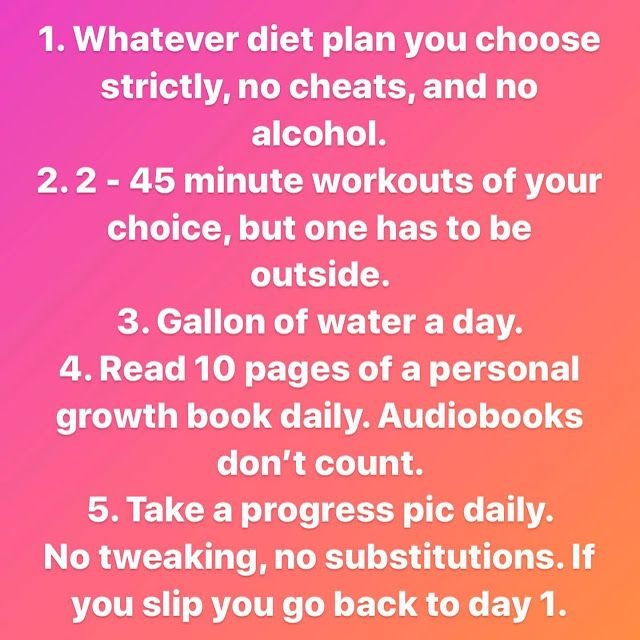
Above are the basic rules for the fad of the year called 75 Hard. As you can see it is fairly straight-forward and may not even look too crazy at first glance.

I want to de-construct this plan for you and reveal the problems inherent with it and suggest something much more simplistic for you at the end.

Problem 1: There is no measurable goal

For any plan to succeed there should be a way to measure and track progress. Otherwise there is obviously no way of knowing if your plan is actually working or not (pretty simple right?). With this 75 Hard the only goal I can see is making it through the 75 days. Important things like: your energy levels, your strength and endurance, your measurements, your weight and BF%, are not considered or tracked.

The only thing “tracked” is a daily photo of yourself. Everything else is just something to check off a daily list. This is a poor idea for two reasons. 1, your physique will not change noticeably from day to day. If you dont know this it will be very discouraging to take a photo each day only for it to look the same as yesterday. This is also why I am not a fan of weighing yourself every day. A better idea is to pick a time once weekly and weigh yourself or take your picture then. That way you have given yourself enough time to actually cause noticeable change and encourage rather than discourage yourself.

2. Although many of us start working out for a vain reason (we want to look better) this way of thinking can be very discouraging to people when they find out that getting that great body that they want takes a much longer time then they initially thought. Focusing on your increased energy, your increased strength, your improved stamina, and your new mental sharpness will move your self talk about working out from, “this sucks but I want a six pack” which will get you through a month maybe to, “I workout for a healthier and happier me” which will make you an exerciser for life. Which in turn will probably get you that six pack you are after.

Problem 2: Aint Nobody Got Time For That!

You know I had to

So let me get this straight. You gotta do two 45 min workouts each day, and one has to be outside? I hope you have enough tren (steroids) to get you through this thing because if you are over 30 you are gonna need it. I’m a (reasonably) jacked guy and I dont work out that much in a day. Why? Because the older you get, the more you need to take care of your joints and the less funny business you can get away with in the gym. It also takes longer to recover from your workout sessions with age. After a week of this you are going to feel like a bag of crap, beat up and tired.

Then there’s the elephant in the room. I mean who has the time to actually do that everyday? Between running my business, working on my house, spending time with my family, cooking real meals, and watching the occasional nerdy show, I dont have the time or desire to workout 90 minutes a day. Let alone workout outside where (as I type this) it is currently a snow covered 19 degrees outside. My wife would probably leave me if I spent that much time working out.

My clients and I get fantastic results just working out 2-3x a week for 30 min to 1 hour at a time. I myself workout anywhere from 3-4x a week for an hour. Years ago before my son was born I lifted for hours at a time but ironically my muscles are bigger and my conditioning is better now even though I workout for less time.

Problem 3: Its set up for you to fail

The last line is the big give-away. If you slip up you go back to day one. This is a recipe for disaster. When you mess up (and if you are not the most try-hard gym rat, you probably will) you will feel defeated and deflated. With each failure you will feel worse and worse about yourself until you give up completely.

As a coach I want to encourage everyone to a lifetime of fitness. Managing expectations, willpower, and motivation is key in creating the habits in someone to make them successful lifelong exercisers. Therefore I will never SET SOMEONE UP TO FAIL AND FEEL BAD ABOUT IT like this program does.

“So genious,” I hear you say, “if I dont crush myself into obvivion with 75 Hard, what should I do?” Great question!

Just Stay Consistent………..That’s It!

The un-sexy, no sales generating, no supplements needed secret plan to become the best fit and confident version of you is consistency.

Ask someone that you know exercises and looks great how long they have been training. They will almost assuredly tell you that they have been at it for years. You see its the hours, weeks, months, and years of training that yield real results. A fad diet or exercise plan cannot replace what hard work over time can do for you. The fad will only leave you feeling defeated and looking for the next fad because “it will be the one that finally works!” but it too will probably not be effective for you and thus the cycle continues.

Hell, the bright side is that with consistency on your side you dont even need the best workout program in the world. Ive seen for years that even a mediocre training program will yield results if it is done consistently and with enough time in-between sessions for recovery.

This simple message of consistency is just lost in the sea of “get lean fast” fads and magic supplements being sold that people dont believe that it can really be that simple. We as a society are so marketed to constantly that we have trouble distinguishing sales copy for real helpful truth.

I myself workout less now than I did years ago and yet I am bigger and leaner than I was. That’s because I train smart and am consistent, not missing workouts. And the clients that are most consistent with me see the same results.

So go forth, schedule those workouts and stick to them! If you keep showing up and putting in the work good things happen, no fad workout plan needed.

Seizing the New Year! (my new three D's for success)

The New Year is always a natural time to reflect upon the past year while setting your sights upon what you would like for your life in the year ahead.

I would be pretty happy just not getting killed by a super bug, or the side effects of the jab to protect against said super bug, or the ever deadly explosive diarrhea.

Assuming I survive all of the above, I wanted to share with you today dear reader (hi mom!) my personal plan of action for the new year. A plan that maximizes my own personal and mental health so that I can be the best I can be for my family and clients.

It will also help me age gracefully, which as I am starting to see sucks pretty bad!

He melted! I’m gonna spend more time in the cold……


Since this is America, and we always have to go big, I call this my Big Triple DDD Plan of Success!


D #1: Ditch Drinking!

I haven’t said anything to anyone (until now) but I challenged myself to a dry January. So no drinking alcohol whatsoever. Which has gotten me now thinking that I should just make this my normal way of life.

We never think about it this way, but alcohol is literally poison to our bodies. As tasty as your favorite beverage may be, it is doing nothing positive for your health. And dont even get me started on the whole “A glass of red wine a day has positive health benefits" bull crap. This is like saying that a little chocolate cake every day has health benefits. No, no it doesn’t, they both spike your insulin, make you retain fat, and slowly but surly damage your metabolic functioning until you get diabetes. And you can get anti-oxidants from like 80 other things that also dont also have poison in them. Its kinda like saying, “you get vitamin D from sunlight exposure, so I’m gonna stay outside shirtless all day long in the summer without sunscreen so I can make a ton of vitamin D!” Its not gonna work out very well for you.

Here's a quick article about it

And any studies about isolating the effects of food or drink are notoriously unreliable because of the sheer number of factors and variables at play. They are almost always intellectually disingenuous and oftentimes downright wrong. With enough data you can make anything say almost anything. But I digress………

Don’t get me wrong, I’m not being holier than thou and preaching down to you. I have always enjoyed adult beverages even to the point of alcoholism in my past. But Ive seen the physical damage done by booze in myself and clients enough times now that I feel that I need to not make it a normal part of my life anymore.

Ive seen enough clients not lose any fat from training because when asked what they did last weekend they respond by telling me about their days of parties and drinking. Then they wonder why the scale isnt moving………

If you wanna lean out much, much faster, then the booze has to go. Ive leaned out this month only from no booze. Now I’m not saying that I will never drink again, but I am saying that I’m going to save it for times of real celebration with my people, and not just drinking on a Friday night because I’m celebrating the weekend.


D #2: Daily Exercise

This one is short and sweet. My previous mindset to physical training was Go Hard or Go Home. I would lift weights 3-4x a week for several hours at a time, really killing myself and pushing hard. With age “wisdom” and a more full and busy life full of commitments I simply dont have the time (or desire) to train as long and as hard as I did before.

I do however want to stay swole and still able to intimidate my neighbors dogs (they are so annoying!) so I gotta train smarter not harder. A simple way to do this is to do less work but more often.

Until you walk funny!

You see, the biggest driver of hypertrophy (getting “toned” or “jacked”) is volume. Volume is the total amount of weight lifted during a session, or a week. So we can manipulate that in a number of ways.

We could either train 3x a week for like 2 hours like I used to before having kids and a life OR we can train more often but do fewer exercises each time. For example (and we are going to keep this super simple) say you do 9 exercises a day (3 sets each) 3x a week. That makes the total “volume” 81, and 27 per day. We can take that 81 and divide it by 5 lets say to make a daily volume of 16.2 which gives us a daily volume of 5.4.

So you could go from doing 3 sets each of 9 exercises 3 days a week to doing 3 sets of 5 exercises per day for 5 days a week and have the same total volume of work done. Therefore giving you the same results and taking less time each day.


D #3: Daily Gratitude

In 2020 I was straight up miserable. I was stressed because the pandemic had all but killed my business, I was working on remodeling our new-to-us house that needed a lot of work, and I wasn’t sleeping a lot because my 1 year old didn’t realize that sleep was great.

I did a lot of complaining both inwardly and outwardly and I blamed the world for my sorry state. This was also not an attractive look to friends, family, and clients who were all going through their own stuff and didn’t need my baggage on top of theirs.

Rather than focusing on what I could control and what I did have I was consumed by all the problems and stressors in my life. I had lost sight of what was truly important. I had a roof over my head, I could still (barely) pay my bills, my family was healthy AND we didn’t fall apart like so many other families were seemingly doing.

When I finally came around and started re-framing my way of thinking to seeing the blessings I did have rather than the struggles before me I felt so much lighter in my spirit. Better yet, with my newfound positive attitude it seemed to attract more people to me. My business came back around and I was able to help others with their struggles by creating a fun energy and atmosphere that was contrary to the state of the world at the time.

So this year I want to ensure that I dont lose focus of what I should be grateful for and maintain an attitude of abundance rather than scarcity.

Practically I’m going to do this by taking a little time as I drink my coffee each morning to reflect on what is good in my life and being thankful for that. Another practical approuch that my wife does each day is to keep a journal in which you record what you were grateful for each day. That way you can even look back upon the months and remind yourself about what is good, even if your life is difficult in that moment.

People are drawn to positivity. I refuse to turn people off by complaining this year. Although I will still share the occasional anti-Fed meme from time to time. Hey both parties are terrible OK!? Not complaining, this is a fact ;) LOL


I would love to hear how you are going to approuch 2022 differently. Lets build each other up this year!


Three Dimensional Breathing (Why and Quick How To)

Very commonly in my practice I see that people have problems with breathing. Even a simple task like a full inhale is often strenuous if not impossible. This may seem kinda silly or inconsequential, but it is indicative of a larger issue, and that issue is a nervous system that is sympathetically dominated.

“But Stephen,” I hear you say, “what does this have to do with health and fitness?” Well dear reader, the short answer is that it has a hell of a lot to do with fitness and health.

You see, if our body was the starship Enterprise (I’m a Star Trek nerd, roll with it) our nervous system would be the ships operation mode. These modes are shields down, normal (parasympathetic) and shields up or RED ALERT battle mode (sympathetic).

The Enterprise D. My favorite

Another (non nerd) way of looking at it is our sympathetic nervous system is our “fight or flight” response. This gets us amped up to run, fight, or move heavy objects. Oppositely, our parasympathetic system is our “rest and digest” response. This response allows us to recover from injury or exercise, digest food, and sleep.

Now you may see where I am going with this. If your body is in its fight or flight mode all or most of the time this causes many problems.

First, your body wont move as well. This is because it tightens up so that it can run fast or fight hard. Eventually this chronic tightness can lead to poor movement patterns, which then will lead to pain and discomfort, which will lead to compensated movement, which will lead to injury.

Second it wont digest and absorb food well. This can lead to IBS, constipation, bloating, fat retention, and a slew of other GI issues.

Thirdly, it will leave you drained and tired. This is because the “red alert” response is stressful (the opposite of restful remember) and isn’t designed to be sustained for long periods of time. This leaves you fatigued or lethargic.

It can cause other issues too, but for the sake of this article I think you get the point. Plus Ive ranted on a bit about this in a past post

So the question becomes why are so many Americans stuck in this state of sympathetic nervous system dominance?

We need less “news” coverage and more self care

There are many reasons for this sympathetic neural drive running our lives so lets just cover two quickly.

Probably the biggest one I believe is the fast pace of American life. Most of us want things done right now or yesterday. And if you dont feel that way then your boss does and isn’t afraid to tell you. We want a pill for everything and an answer to anything that takes longer than an episode of Squid Games is simply unacceptable. This gets everyone worked up and moving fast, which engages the red alert signal constantly.

Another big one I believe is fear. Especially after 2020 I think its pretty clear that we are inundated by a fearful culture driven primarily by the media (whether you are left, right, or center this is true). The truth is that we are the safest we have ever been in the history of the world. If you dont believe me, look it up. Here’s a start. And even if we weren’t in a safe environment, a lot of the things we tend to get worked up about we have very little control over anyway (politics, politicians, taxes, foreign countries, certain illnesses, your cat exc). If you are fearful you cannot rest and therefore cannot recover.

Here are two quick tests to do on yourself to see if you have an overly active sympathetic nervous system.

  1. Bend over and touch your toes. That’s it. Cant do it? You are probably in fight or flight.

  2. How is your sleep? Do you have trouble sleeping or staying asleep? That’s a big sign of a sympathetically driven nervous system.

SO……WHAT DO WE DO ABOUT IT!? A very simple thing that has a huge effect on your nervous system is breathing.

“But that’s dumb Steve I breathe all the time!” You say. This is targeted, purposeful breathing that will bring you down into a parasympathetic state. Its not your shallow autonomous breathing.

Watch the below video for a quick explanation and example.

I forgot to mention in the video to keep your legs bent like I do. This keeps your pelvis level and we want to have a properly stacked core “cylinder” when 3D breathing.

My recommendation is to start and end your day working on 3D breathing. You are already in bed so it makes this easy to do. This exercise can take as little as 3-5 minutes so there is really no excuse here. Just make sure you dont have TOO many pillows under your head while doing this. Stick to one or two pancakes.

I know it sounds crazy, but give it a shot, you wont regret it. It makes a huge difference and I see the difference it makes in my clients all the time.

If you have any questions feel free to shoot me an email!

Losing body fat (3 simple take a ways)

I just wrapped up my big 6 week body transformation challenge this weekend and I feel like it went really well. Everyone who participated lost body fat! Even if they didn’t lose weight on the scale they did manage to lose fat around their waist (which is more important than a simple metric like your body weight).

Today I’m reflecting on the challenge and the habits of those who did really well vs those who changed only a little bit. Ive narrowed it down to the top 3 most important factors when trying to lose body fat.

1: Stick to the plan!

Most people switch back and forth between diet plans too often

Most people switch back and forth between diet plans too often

This one seems fairly obvious but I feel that it needs to be stressed here. If you dont stick to the plan, guess what, it wont work! I’m not going to talk about what style of eating works best for fat loss in this post (since that would be a post in and of itself) but research has shown that people can be successful with many different styles of diet plan.

That is if the dieter actually sticks to said diet. I am constantly amazed at how quickly people get discouraged with their diet plan and just give up. I have two stories from my challenge to share.

I had one client who got angry and discouraged after one week of her diet plan because she gained 2 pounds after 5 days on the diet. I tried to explain that the weight gain could be because of many different factors (time of the month for ladies, hormones, stress/inflammation, or not actually adhering to the diet) and that it was very short sighted to simply quit after 5 days. I couldn’t talk her out of it and she joined weight watchers and subsequently stayed mostly the same through the rest of the challenge. She lost a small bit just due to exercise.

The client who lost the most body fat during the 6 weeks was on the other end of the diet adherence spectrum. He only had 2 cheats that I can remember during the challenge and stuck to the diet during the rest of the time. He lost more than the rest of the group by a large margin. Coincidence? I think not dear Watson.

And one final note on this point: You can undo all the good work you made on your diet by throwing it away with bad food and alcohol on the weekend! This is probably the #1 problem I see with half of my clients.

2: Get your family on board!

We have all been this cat once in our lives

We have all been this cat once in our lives

Making any dietary change whether it be a short term diet or a total rework of what you eat for the long term is difficult. What can make this even more difficult (if not impossible) is if your own family sabotages you!

Lets say you are a mom of 2 kids and you want to start eating healthier. Your kids are both under 8 years old and your husband doesn’t know how to cook anything other than microwave popcorn. When you plate the family dinner for the night which consists of a nice salmon with steamed broccoli and a green salad, your family starts revolting like its LA during the Rodney King riots. The kids want the sugary junk that they always want and so does your husband albeit in a different carby sugar form. After a few days of this you throw in the towel and go back to eating junk again. You feel like a failure and the gleeful reaction of your family doesn’t help.

I’ve seen this happen time and time again over the years. Your waistline will rise or fall with that of your family. Your willpower to resist eating the mac n cheese that your spouse has made for dinner while you eat a salad will only last so long before its exhausted and you go back to your old ways. It is imperative that you at least get your spouse onboard with your new meal plan. Its even better if you can get (or force lol) your kids to do the same.

3: Don’t wing it! (meal Prep)

Seriously….don’t

Seriously….don’t

Let’s say that you are at work and its lunch time. You haven’t brought a lunch and unfortunately the only 2 restaurants near your workplace are Taco Bell and McDonald’s. You resign yourself to one of the choices and tell yourself that your healthy eating will start tomorrow. The next day this happens again because you didn’t pack a lunch. The day after that goes the same way also. You see where I’m going with this…..

You know the saying right? Those that fail to plan plan to fail. This is never more true than when it comes to losing body fat. Your energy and will-power throughout the day are a finite resource. When you are beat after a long day and its dinner time and you have no idea what is on your menu that day (even if you have enough healthy ingredients) you are more than likely going to grab whatever is fast and easy. Once this happens enough times even if you have the best intentions you will find yourself disappointed, unmotivated, and defeated.

Best case scenario you use one of your days off to buy food, plan meals, and prepare meals (especially lunches) for the week. This is critical to success both long and short term.

Are there any other keys to successful fat loss dieting that you have found? What are some hangups that you have had to deal with? If you need help in this area reach out and I will be happy to help.

Walking Shouldn't Hurt! (Make sure your walking mechanics are sound)

I’ve seen it time and time again now. A client starts working with me and during their initial intake questionnaire they mention how walking for any distance (beyond going to the fridge from their couch) makes their knees and/or hips hurt. Then, during their first movement evaluation with me it becomes clear as to why they suffer when walking. I see even more clients that can walk OK, but when they run or jog BOOM, there is a serious problem in their ankles, knees, or hips.

Today I would like to go more in depth about walking mechanics and give you some simple things to keep in mind and look out for if you yourself have issues with locomotion. The best part is that I will keep this fairly simple and actionable because if you are like me you want the TL;DR more than anything. Heck, I’m even gonna include a video explanation!

Aint nobody got time to read some crazy long article with a bunch of anatomical jargon!

Aint nobody got time to read some crazy long article with a bunch of anatomical jargon!

Who needs reading!?

Watch the video if you dont feel like reading. If you are on AOL dial up from 1995 and you can’t load my video, read on!

Alignment is KING!

When I screen someone for walking issues the #1 cause of problems I see is t̶h̶e̶i̶r̶ ̶l̶o̶v̶e̶ ̶o̶f̶ ̶c̶o̶u̶n̶t̶r̶y̶ ̶m̶u̶s̶i̶c̶ ̶ misalignment of the hip, knee, ankle, and foot.

In order to determine if your alignment is good or bad, have someone take a video of you walking from both the front (towards the camera) and the back (away from the paparazzi). Are your knees traveling over your toes or pointing our towards the sides? Are your legs in straight lines from the hips down, or do your feet point out or in?

For proper alignment you want to see a straight line from your hip, through your knee, down to the ankle and foot. Your knees should be traveling over your toes (somewhere in-between your big and little toes) and not moving away from or towards your mid line.

An easy way to determine this is to look at what direction your knees are facing when you are standing. Have someone take a picture of the back of your knees (exposed skin) and look at what direction the back of your knees are “facing”. Imagine you had to draw a line from the middle of the back of your knees through your leg and in front of you. Would that line be straight over your toes, or does that line go to the left or right of your toes? You want to get an idea of this in both standing and walking.

Your feet are super important!

If you have knee pain and you take nothing else away I want you to hear this. Problems with the knees are almost always driven by the feet or the hips. That’s because the line of knee travel as you walk is dictated by your hips and feet.

A common fault I see in people is that they walk on the outside of their feet. This creates a bit of external rotation in the ankles and knees and makes walking unpleasant. That’s because the knees are now pointing outward rather than forward. Remember how we just talked about how the knees pointing out or in too much was bad? Well that can be easily driven by walking on the outside of your feet. This means that when you are walking your big toe is usually pointed up, and not in contact with the ground.

So, a quick fix (or something to try) for that is to make sure your big toe is the last thing that leaves the ground when you are walking forward. You see, your big toe is the main driver of propulsion of your foot as you walk/run and it also helps keep the knee pointed in the right direction, which is straight ahead. You should not be “pushing yourself forward” with the outside of your foot. It just doesn’t work well! And before long your knee is going to be letting you know that its a problem.

Tripod Foot

One technique that is helpful in re-patterning how the lower extremity works is the concept of the tripod foot. This is as simple as working my Keurig in the morning!

All you have to do is make sure that you keep your weight evenly distributed through your entire foot while you are doing exercises like a squat or deadlift. So you want the weight of your foot evenly divided between your big toe, your little toe, and your heel. Technically you want it on the bones behind the big toe and little toe, but that’s just not as memorable to say.

As you are performing your exercise pay attention to where the weight is on your feet. Do your toes always lift off the ground? Do your heels come off the ground when squatting? These are both indicative of problems. Make sure to do this without shoes on, especially when you start learning the tripod foot because this is very difficult to learn in modern athletic shoes with all their support and padding.

thats it.png

Try out these suggestions and let me know how it goes! Sometimes it changes things radically immediately, and other times it takes some release work and practice to get everything to move in the right direction.

Make Sure You Make Gains (Progressive Overload)

I’ve been in the gym for a lot of years now. I’ve worked out in many giant commercial gyms and been employed by other giant gym chains and the YMCA. So after all these years its safe to say that I have seen a lot of things……horrible things that cannot be unseen!

It was pretty much this on a daily basis

It was pretty much this on a daily basis

You see, I saw so many people doing silly, dangerous, and downright ineffective exercises all the time. For a long time my viewing of this daily dog and pony show made me want to violently shove my lunch fork into my eyes. To make matters worse, when I observe clients working with MOST personal trainers I see programs and exercises that are not much better than the picture above. There is no real structure, plan, or progression to the programs that these trainers are putting their clients through.

I realize that people dont know what they dont know, and so these clients trust their coach to lead them to their goals and they dont realize that they are being put through sub-optimal or even sometimes dangerous programs.

I dont want that for you dear reader! So rather than create an exhaustive list of “good and bad” exercises (which could fill a volume) I am going to give you the most powerful training principle that you need in order to always make progress in the gym.

Progressive Overload

Progressive Overload is probably the most important (and often overlooked) principle in gaining strength and losing fat in the gym.

The angels sing of Progressive Overload

The angels sing of Progressive Overload

In a nutshell progressive overload means that you need to gradually put more and more stress on the body in the gym in order to build muscle and strength. You see our bodies desire to settle into what is called homeostasis. This means that our bodies like to self regulate and keep us at a certain base level. So in order to build muscle or lose fat we must disrupt this homeostasis by lifting weights.

For example, lets say that you start lifting in a group exercise class. The class is fast paced and uses dumbbells. It kicks your butt for the first 2 weeks. Then on the third week you find that it is considerably easier and you feel really good about yourself (go you!). Weeks four and five go by and you have the group workout down pat. You are the class rockstar! Several months go by and you keep slaying the workout but you notice that you dont look that much different in the mirror. What is going on?

The group class using the little dumbbells that you have been attending religiously has neglected the holy ghost of training: progressive overload. You see, the group class starts off as a new challenge for you. Your body is only used to going to work and then sitting on a couch, so the class is great and you see some results right off the bat. This disrupts your homeostatic point. After a few weeks though, your body has gotten used to the group class and its not as challenging. Your body has reached a new homeostatic point! It has adapted to the demand of the workout, and now in order to keep progressing and becoming more fit your body needs more of a challenge.

This is why after several months of this, you dont see a ton of changes in your physique. Its because the workout hasn’t really changed much. You also see this with home workout videos. Sure, they work for a few weeks or even months, but they usually are not built with progressing in mind and will eventually leave you stagnant.

In order to keep growing (in our example above) you would need to increase the weight of the dumbbells used, increase the number of reps performed, or otherwise increase your time under mechanical tension in the group exercises.

So How Does it Work?

“Stephen you lover of iron,” I hear you say, “how does this work practically in my workouts? I keep This pretty simple in my own programming and that of my clients. Most importantly you have to keep one thing in mind each time you train. Have I tried to do more this workout than last workout?

And neither was anything worth having

And neither was anything worth having

With body weight exercises (like push ups, pull ups, crunches exc) this is very simple. Just do more than the last workout. For example, if you can eek out 3 sets of 3 push ups at first, then next workout simply try to do an additional 4th push up. Before long you will be adding 5th and 6th push ups and not long after you will be much stronger and proficient in that exercise.

With weights its a little more complicated (but not much). Say you start off dead lifting a 35lb kettlebell off the floor for 3 sets of 8 reps. Next week try doing 10-12 reps for 3 sets. The week after try using a 52lb kettlebell for 3 sets of 8 reps again. You see how this works? You want to increase the reps and/or the weight each week in order to see sustained progress and great results. Easy enough eh?

To be clear, there are some weeks where this is not possible. Sometimes you will have not sufficiently recovered and adapted from your training because of bad sleep, high stress, a bad argument with your significant other, your house is haunted because its built on an Indian burial ground, or any other number of things. Realize that this is ok and is part of the process. Just go get em next week!

TLDR

You dont need to change up your program constantly or always be on the hunt for the exercise that “works your thighs best.” What I challenge you to put into practice is to always try to do just a little bit more each workout. It doesn’t even have to be for every exercise every workout! But by doing just a little more you will find that little bit at a time adds up to big changes in the long run.

Now go build your Rome.

Your Life Bar (Accumulative Constructive Survival Value)

Have you ever played a video game? I am a video game fan and have been for a long time. In many video games your avatar or character you are playing has a life bar somewhere visible on the screen. This life bar is a graphical representation of the vitality or health of your character. When it goes all the way down or to zero, your character is knocked out or killed and you obviously lose the game. This is usually followed by a “respawn” in which you play the game again but may have to start at the beginning again. Or you just rage quit the game all together and throw your controller. I dont know anything about that…..

The life bar depletes as they strike each other.  And they spelled critical wrong

The life bar depletes as they strike each other. And they spelled critical wrong

“But Coach Boone” you say, “what does this have to do with health and fitness!?” Well impatient reader, this is a good analogy for two ideas taken from Chiropractic teaching called Accumulative Constructive Survival Value and its opposite, Accumulative Destructive Survival Value.

In my video game example above, I am referring to the accumulative destructive survival rate firstly. In real life these are the things that “drain your life bar.” These are life stresses, physical stresses, injuries, traumas, disease, toxins, fatigue, age, being punched by a ninja, exc. All the things that make us run down, injured, or sick. Even in real life we only have so much physical capacity or “life bar” and all of these different factors in life chip away at our capacity. Also like a video game, once our capacity reaches zero, we can be killed by ailment or injury. Unlike a video game however, there is no respawn option, the game is over for good on earth.

Do not pass go, do not collect 200 dollars.

Do not pass go, do not collect 200 dollars.

On the other side of the coin we have Accumulative Constructive Survival value. These are things that increase your “life bar.” These are things like healthy foods, exercise, vitamins and minerals, rest, prayer and meditation, laughing, massage, exc. These things restore your vitality.

The concept though is not as simple as things that simply heal you. For example, if you have a disease simply resting and eating vitamins wont necessarily heal you. The idea is that things that add to your constructive value give you more overall capacity and resiliency against the stresses and sicknesses of life (the destructive values).

You could also think about it this way. You are a bucket. There is a constant stream of water being pored into you (the bucket). If the bucket overflows with water, you die. The water can be drained out somewhat slowly also, but normally the water comes in faster than it leaves. BUT what if you could be a larger bucket? This way you can hold more water safely and not risk it overflowing. This is working on your Accumulative Constructive Survival Value.

You see your body’s natural state is one of health and healing. This is evidenced in small part by how our wounds heal. Like if you get a paper cut its gone in a couple days. Our bodies are programed in our subconscious to heal, repair, and thrive. If you can keep a reserve of life bar or extra room in your bucket, your body will start the healing and repair process. If you are dangerously close to overflowing or zero life, your body is overwhelmed and has an extremely difficult time of restoring health or repairing itself.

This is why healthy eating and exercise are so important and helpful to us. These are two of the lowest hanging fruit we have at our disposal to increase our Accumulative Constructive Survival Value and keep ourselves healthy and able to withstand the stresses, toxins, and ninja kicks that life throws at us all the time. Yes our overall Constructive Survival Value will decrease with age (our overall life bar is maybe max 75% rather than 100%) but hopefully our wisdom in navigating life and keeping our constructive value topped off, and destructive values at bay will let us lead a healthy life right up till the end.

I watched both sets of my grandparents health decline slowly over years as they suffered more and more with disease until they died. What I didn’t understand at the time was that they were not doing anything to grow their bucket. Most things in their life only added more water in. I don’t want this for myself and I dont want it for you either dear reader.

As I always say, “live a healthy life and then drop dead.” Who wants a long suffering state of being when you get old? By keeping these values in mind and adding to our constructive survival value as much as possible, hopefully we can avoid suffering and live in health till the end. What are you doing to keep your health-bar up?

I dont know about you but I want to be able to sword fight pirates and yell at kids to get off of my lawn for as long as possible. Who’s with me?

Inflamation and what to do about it (in short form!)

We have all heard talk by now of inflammation and its effects on the body. It is not my intention in this post to go in depth into the root bodily mechanics of inflammation but rather to give you a very practical (and fast) download into some common signs/symptoms of inflammation and some common food triggers. If you know me you know I am a HIGHLY practical individual so rather than wax poetically about it, just know that inflammation is bad mkay and we normally want as little of it as a response in our bodies.

If you dont know who this I’m sorry you arn’t having enough fun in life

If you dont know who this I’m sorry you arn’t having enough fun in life

3 signs/symptoms of Inflammation

  1. Fatigue: Are you tired all the time? When you wake up does it feel like you drank last night even though you didn’t? This is a very common inflammatory reaction to food. Might be time to look at your diet.

  2. Weight Gain/stubborn fat: If your body is in a chronically inflamed state it will typically hold onto fat stores. This is because your body is having a sympathetic nervous system response. Conversely, it can also make it hard to lose fat since your sympathetic (fight) response is on. So if you are working out, eating better, and still seeing no chance on the scale, inflammation could be why.

  3. Joint Pain: Do you feel achy all the time? Do you still feel achy even in the afternoon after you have been up and moving around for a while? You see we should (if things are working properly) feel more mobile and less “achy” as the day goes on. A little ache in the morning isnt a big deal but if it doesn’t go away this could be a sign of chronic diet induced inflammation.

3 Common inflammatory foods that are even “healthy’!

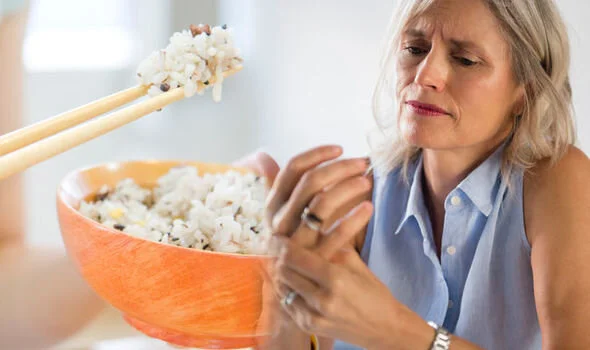
  1. Rice: Although rice is one of the most commonly eaten foods in the world, it is also a very common cause of inflation in westerners who often lack the enzymes that are necessary to process rice properly. This is one lesson I had to learn the hard way myself. I love rice and Asian cuisine and I always wondered why I would spend a long time in the bathroom and with stomach aches after virtually any Asian meal. Well, they almost always come with rice, and my Norse heritage doesn’t do so well with that.

This lady feels me. Rice has been linked to joint pain. Its almost like I knew what I was talking about

This lady feels me. Rice has been linked to joint pain. Its almost like I knew what I was talking about

2. Beans: Beans, beans the magical fruit! They also have another magical power, and that’s the power of inflammation! You know what I’m talking about. The bloated, stuffed full, and gassy feeling after having a bunch of beans. Its so obvious and yet we are told that beans are a health food! The bean issue is pretty nuanced though. Some beans are pretty common inflammatories while others are not. It also matters how the beans are washed and prepared before cooking. Its outside of the scope of this article to dive into it but the short version is green beans are fine while most of your hard beans like black, pinto, navy, exc can be problematic. I cut them all (but green) out of my diet and feel much better for it. If you are a bean lover it may be worth more research on your end.

3. Breads, pastas, even whole grains: This one is pervasive and incredibly common. There are many people who have trouble digesting wheat based grain products. Yet these products make up the majority of options in any grocery store. You see, wheat allergies are very common. Symptoms like acne, skin rashes, and headaches can all be caused by wheat consumption. Hell, our wheat in the USA doesn’t even meet European standards (dont believe me, look it up). Although whole grains are often touted as a health food, I would recommend staying away from them. Your health (and waistline) will thank you.

What to do about it

  1. Pay Attention!: Pay attention to how you feel about an hour after eating. If you are tired and want to take a nap its highly likely that your body doesn’t like something you ate and is reacting to it. A good meal (for you) should give you more energy, not less.

  2. Everyone is different so become a detective for yourself: One thing that drives me nuts is the notion that there is one “perfect diet” for everyone. This is simply not true! People are very unique and because of our diverse ancestral backgrounds we will react to foods differently as well. For example, I have a buddy who can eat rice likes its his job and he stays lean year round. Hes also Asian. Me on the other hand, even a small amount of rice makes me feel like a sumo wrestler and I spend the rest of the evening in the bathroom watching YouTube. To find the perfect diet for you takes work, trial and error, and experimentation.

  3. Its so worth it: When I talk to my clients and tell them the un-sexy truth that there is no magic diet or pill they can sometimes become discouraged or overwhelmed. People seem to want a play by play guide of exactly what to eat and when. This isnt very realistic however and as soon as you go out to dinner with some friends you will “fall off the wagon” and then feel bad about yourself. This is not a sustainable way of living! I think some re-framing is needed here. You should look at this as an exciting and life changing journey of discovery to enbark on! If you can learn about yourself well enough to know what foods serve you well and which ones dont then you have armed yourself with the ability to eat almost anywhere! You can enjoy dinners out with friends and simply order what you know fuels you instead of just cheating on your diet and paying for it later.

go forth.png

Now go! Listen to your body. Eliminate foods that cause inflammation and make you feel bad. Create your own non-inflammatory diet that you can enjoy and will serve you for your life!